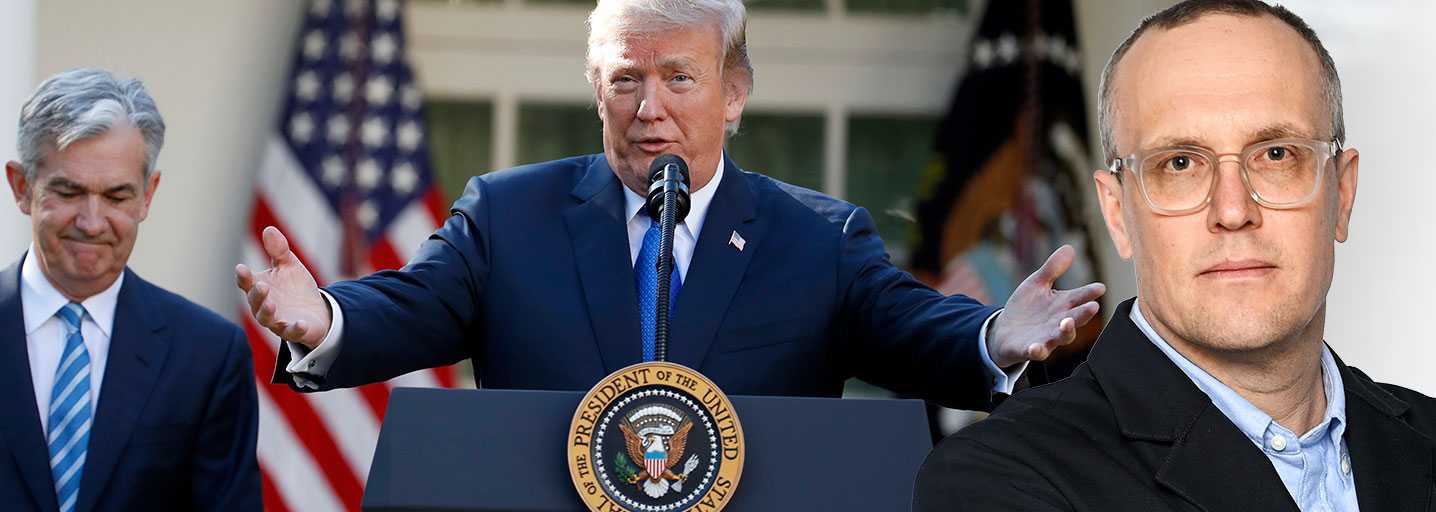
Trump's move backfires - now US power is threatened
The dollar in free fall - US power is threatened
Trump's move backfires - now US power is threatened
Andreas Cervenka
Reporter and economic commentator
This is a commentary text. Analysis and positions are those of the writer.
Published 13.37
Speculation that Donald Trump will try to fire the head of the Federal Reserve is causing the US dollar to plummet. Confidence in the currency is now in turmoil - something that could threaten the US's position in the world.

On August 15, 1971, the world economy fundamentally changed. At that time, the then US President Richard Nixon announced that the US was abandoning the so-called Bretton Woods system that had governed the world since 1944.
The system was simple – all the world's currencies were tied to the US dollar, which in turn was linked to gold at a fixed price of $35 per ounce (31.1 grams).
Anyone who was worried about the value of the dollar could exchange their paper money for gold.
The fact that some countries had begun to consider doing just this contributed to Nixon's decision.
Since then, the dollar has continued to function as the world's reserve currency – which has meant, among other things, that the US has been able to borrow money cheaply for decades and that all important raw materials are priced in dollars.
The dollar can be described as the US's most important weapon.
Its value is not linked to any physical commodity but is based solely on trust.
With Donald Trump in power, that trust now appears to be beginning to be questioned – an event that has been described as as transformative as Nixon's speech in 1971.
"The US has benefited from the dollar's status as a reserve currency for 100 years. It has taken less than a hundred days to dismantle it. It is a very big deal," Gregory Peters, a manager at the fund manager PGIM, told the Financial Times.
This is visible in the dollar's exchange rate compared to other currencies. Against the euro, the dollar has lost 11 percent this year and against the Swedish krona almost 14 percent. One dollar cost 9.55 kroner on Tuesday compared to 11.25 kroner in mid-January.
The crisis of confidence is perhaps most clearly visible in the price of gold.
The price of gold reached over 3,500 dollars for the first time on Tuesday and has now risen by 17 percent since Donald Trump's speech about tariffs in early April. In one year, the value of the dollar, expressed in gold, has lost 48 percent. It is starting to resemble a free fall.
The latest reason for the dollar weakening and gold rushing is Donald Trump's actions against the head of the Federal Reserve, Jerome Powell.
Last week, Donald Trump declared that the Fed chairman, whose term expires in May next year, cannot end soon enough, and this weekend, White House economic adviser Kevin Hassett declared that the Trump administration is exploring the possibility of firing him.
On Monday, Trump made new statements against Jerome Powell, demanding that he lower interest rates immediately.
The Federal Reserve, like other central banks in the Western world, is intended to be independent of political power. Jerome Powell himself has been clear that it would be illegal for Trump to fire him.
This can only be done if there are valid reasons, such as some type of mismanagement, not just because the president disapproves of the interest rate level.
But the rules are based on a 1935 court case in which Franklin Roosevelt tried to get rid of an agency head he didn't like.
Some analysts believe that Donald Trump will try to have the issue tried in court and thereby explore where the limits of a president's power really are.
If a lawsuit were to be filed, the issue would ultimately end up in the US Supreme Court, but in the meantime, such a battle would create great uncertainty.
The fact that central banks should be independent is not entirely uncontroversial - the issue has been discussed a lot in the years after the financial crisis, when banks conducted large-scale experiments with negative interest rates and created enormous amounts of new money.
But the alternative has been considered much worse: the risk of power-hungry politicians taking over interest rate setting and the central banks' money printing presses.
Historically, this has often led to confidence in the value of money being pulverized, resulting in hyperinflation.
The independence of central bank is not entirely uncontroversial – the issue has been much debated in the years since the financial crisis, when banks conducted large-scale experiments with negative interest rates and created enormous amounts of new money.
But the alternative has been considered much worse: the risk of power-hungry politicians taking over interest rate setting and the central banks' money printing presses.
Historically, this has often led to confidence in the value of money being pulverized, resulting in hyperinflation.
The road to Trump taking direct control of the Federal Reserve is long – it is not enough to fire Jerome Powell, since he is only one of twelve members of the committee that sets interest rates – but the mere thought of the central bank becoming politicized is enough to make the financial market nervous.
The rest of the world has invested enormous assets in the United States and in dollars.
In total, foreign investors own stocks and bonds worth $31 trillion, more than the entire US GDP.
There are already signs that many investors are starting to reduce their exposure to the increasingly capricious US.
If the sell-off continues, it could hit the US economy hard. The increasingly weak dollar makes it even more expensive to import on top of Trump's tariffs, and when interest rates rise, it will be more expensive for the US to borrow.
There is no other currency that can take over the dollar's role overnight - but the euro's position is likely to strengthen and China, Russia and other countries have already tried to reduce the dominance of the US currency.
Donald Trump has just given them a real boost.

Inga kommentarer:
Skicka en kommentar