
Wolfgang Hansson
Wishful thinking behind speculation about Putin's terminally ill
Published: Today 17.34
Updated: Today 18.45
This is a commentary text. Analysis and positions are the writer's.
COLUMNISTS
All reports on Vladimir Putin's health lack an important component.
Evidence.
We really know nothing or very little about the Russian president's state of health.
Speculation may be the result of wishful thinking that Putin will soon die and the war will end.
Barely a day goes by without Western media, including Aftonbladet, publishing new information about how seriously ill Putin is.
One day he suffers from fatal blood cancer. Next is Parkinson's or dementia.
Recently, two British tabloid newspapers went so far as to claim that Putin is already dead and has been replaced by a double, according to sources in the British intelligence service.
The majority of the tasks have one thing in common.
Those who speak are either anonymous sources or individuals with no access to either Putin personally or his medical record.
This includes people like Christopher Steele, the former British agent who before the US election in 2016 spread rumors about Donald Trump's alleged sex orgies during a visit to Moscow.
Here is also the head of Ukraine's military intelligence service, who states that there are no propaganda motives behind his claim that Putin is seriously ill.
Fatal cancer
The latest wave of speculation about Putin's health began in connection with Russia's invasion of Ukraine on February 24, but this is far from the first time the Russian president's health has been hotly debated.
As early as 2008, a study conducted by the CIA established that Putin probably suffered from Asperger's syndrome. Several years before that, his movement patterns were alleged to indicate that he had had a stroke or suffered from trauma from childhood.
Even after Russia's annexation of Crimea, Putin's state of health was brought to the fore. Several Western media outlets reported that he was suffering from fatal cancer.
I'm not writing this to rave about information about Putin's possible fatal diseases.
He may well be seriously or even terminally ill.
My point is that we have no idea.
As far as I can tell, there are no sources with real insight into Putin's state of health that have commented on the issue. Not even the anonymous sources seem to be particularly close to power.
We know a few things. In April, the Russian investigative site Proekt leaked documents that are said to show that the Russian president on many trips is accompanied by a number of doctors with specialties that could indicate that he has thyroid cancer.
Russian President Vladimir Putin during a meeting in Moscow a month ago.
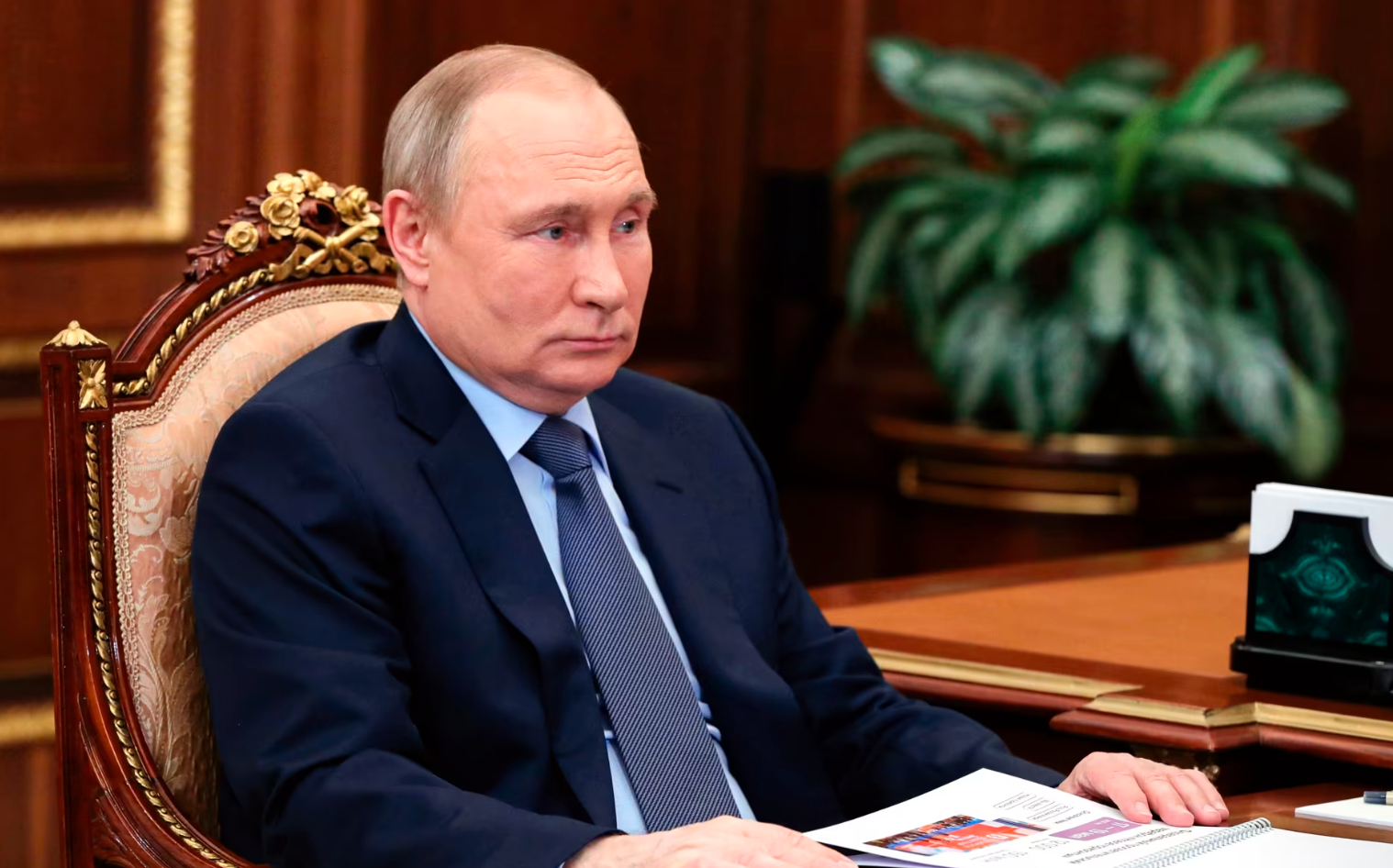
Russian President Vladimir Putin during a meeting in Moscow a month ago. Photo: Mikhail Klimentyev, Sputnik, Kremlin Pool Photo via AP
Conscious disinformation
But could just as easily be a hypochondriac Putin who wants constant access to a doctor in case something happens.
It is not uncommon in times of crisis and war to speculate on the health of dictators. It was the same with Saddam Hussein during the Iraq war or with North Korean leader Kim Jong-un when he rattled off his nuclear weapons.
Speculation can be deliberate misinformation to harm leaders. If the circle around Putin thinks he is ill, it could trigger an attempt to force him out of power, which is exactly what the West is hoping for.
But the spread of rumors can also be a manifestation of wishful thinking.
Because if Putin is terminally ill, it means that he will soon be out of power and that Russia may then withdraw from Ukraine. Or at least become more willing to negotiate an end to the war.
Many of us like to think that Putin is terminally ill. Therefore, we like to revel in rumors that confirm that image.
Putin himself made a contribution in two speeches he gave just before and after the invasion of Ukraine began on February 24.
He spoke partly incoherently and gave a confused impression. He was not his usual, cool self. Somehow he seemed to have changed. In addition, his face has often looked swollen in recent months.
During his performance on Victory Day on May 9 in Moscow, he had a blanket over his legs when he sat down even though it was nine degrees in the air.
Error calculation
In other words, the rumors about Putin's poor health may also serve as an explanation for why he made such a gigantic miscalculation and started the war against Ukraine. Putin knows that his days are numbered and puts everything on a card.
He still has nothing to lose.
Which, of course, is another possibility.
But Putin will soon be 70 years old. He's an older man. Physically far from the macho images he liked to spread by himself in a bare torso on horseback. At 70, it is not uncommon to suffer from ailments that make you tremble, walk a little stiff or gain weight.
It is unusual for people close to Putin to respond to the rumors. Foreign Minister Sergei Lavrov said the other day that "Putin appears in public every day(Putin framträder offentligt varje dag.) No normal person can see signs of illness or poor health in that man ”.
The fact that the Kremlin is making every effort to counter the speculation can be interpreted as a concern to dismiss them as untrue. Whether they are or not.
Perhaps Putin's isolation plays an equally important role in his miscalculation. During the pandemic, he met few people. Anyone who wanted a physical meeting with Putin had to be quarantined for two weeks in advance. Maybe Putin got a little crazy about his loneliness.
Look at that; yet another unconfirmed speculation.

Inga kommentarer:
Skicka en kommentar