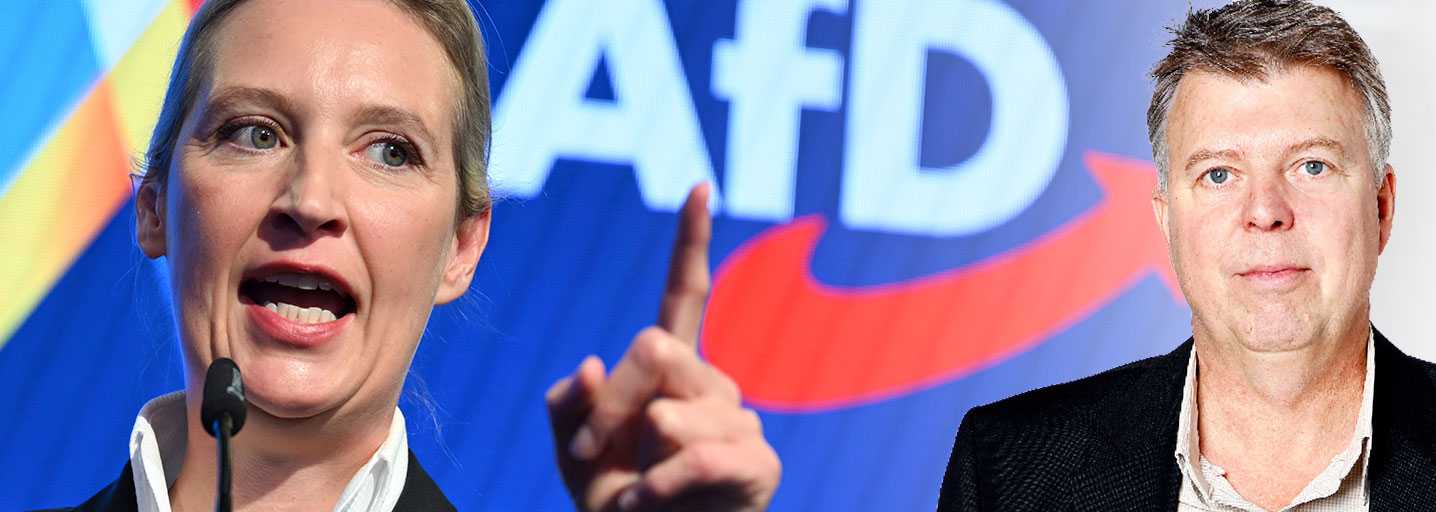
Labeling the party as extreme could backfire
Categorizing it as far-right could backfire
Labeling the party as extreme could backfire
Wolfgang Hansson
This is a commentary text. Analysis and positions are those of the writer.
Published 20.28

The decision by the German Federal Constitutional Court to classify the German party AfD as far-right could certainly be interpreted as an attempt by established society to harm a political opponent.
But for many Germans it is a signal that the country is now dangerously close to the possibility that Nazism or a similar movement could return to power.
Quick version
In the elections held in February, the Alternative for Germany, AfD, became the next largest party with just over 20 percent. Almost double compared to the last election.
The AfD has its greatest support in eastern Germany but is also growing in the west.
The party now has 152 seats in parliament and, if the normal rules are followed, would be entitled to chair positions in some of the committees.
Opinion polls conducted after the election also show that the party has grown further since the election. In some polls, they are overtaking the ruling CDU party and becoming the largest party.
This in a Germany that, with the motto “never again”, has promised never again to let totalitarian movements take power in the country.
Never again will a demagogue like Adolf Hitler be able to transform Germany into a totalitarian state and carry out mass murder. The Holocaust took the lives of six million Jews.
The AfD is not a Nazi party, but there are those in the party who seem to think that Nazism had positive sides.

One of the party’s leaders, Björn Höcke, has been convicted of using banned Nazi slogans at his election rallies. There are other representatives who have tried in various ways to mitigate the Nazis’ crimes.
The party's main issue is to put an end to immigration to Germany, especially the immigration of Muslims. The party wants to see a return migration. Something that many interpret as wanting to mass expel migrants from Germany.
Therefore, some branches of the party were already classified as suspected right-wing extremists. But now the German Federal Office for the Protection of the Constitution, a state authority tasked with ensuring that the German constitution is upheld, has classified the entire party as “declared right-wing extremist”.
The main reason is that it believes that the party does not respect the first paragraph of the basic law on the equal value of all. The Federal Office for the Protection of the Constitution does not believe that the party treats migrants with a predominantly Muslim background as equal to ethnic Germans.
In practice, this means that the party is given a pariah status and that it becomes easier for the German intelligence service to monitor and infiltrate the party.
But some politicians from the Christian Democratic Union (CDU) and the Social Democrats want to go further than that. They believe that the AfD must now be banned.
SPD leader Lars Klingbeil, finance minister in the new government, says that a ban will be considered.

Ultimately, it is a decision that must be made by the country's constitutional court. But the bar for a ban is very high. Attempts to ban the small neo-Nazi NPD have previously failed.
In Sweden, we have no direct equivalent to the Constitutional Protection Act. But it would be as if the Swedish state were to classify the Sweden Democrats as far-right.
You can imagine the outcry that would lead to.
For a long time, it was considered impossible for a far-right party to achieve success in Germany. German history was seen as a vaccination against all such trends.
But human memory is short.
Soon there will be no more survivors of the concentration camps of World War II. Soon there will be no more Germans who remember the war.
The genocide and dictatorship of that time will be forgotten.
That is why the AfD's successes scare many.
During the AfD's short history, the party was formed in 2013 as an anti-EU party, other parties have applied a firewall against the party. All forms of cooperation have been banned.

But of course there are those who are critical of the Constitutional Court's decision. Not least the AfD leadership, who believe that it is about political persecution and a way for the established parties to get rid of them. They intend to appeal the decision.
Others warn that the classification as far-right could have the opposite effect to the intended one. Instead of scaring away voters, it will attract those who have lost confidence in the traditional parties. Those who want to protest against the establishment.
The decision comes at a sensitive time when Germany is about to have a new government with CDU leader Friedrich Merz as Chancellor. He who for a short while during the election campaign seemed willing to take the support of the AfD before he was forced to resign.
One of Merz's main tasks will be to deal with the Trump administration and the US trade war.
The cooperation looks to be off to a bad start.
Secretary of State Marco Rubio calls the decision on the AfD "tyranny in disguise". Vice President JD Vance claims that Germany is rebuilding the Berlin Wall by labeling the AfD a pariah.
During the German election campaign, both Vance and Elon Musk gave their support to the AfD.
This means that the US and the new German government could immediately end up on a collision course.
The German Foreign Ministry responded to Rubio's X with the words: "This is democracy. We have learned from our history that right-wing extremism must be stopped."


Inga kommentarer:
Skicka en kommentar