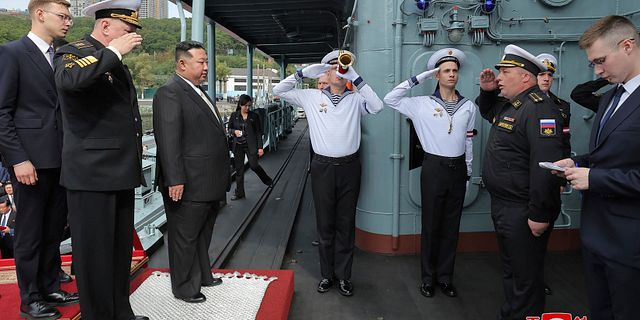
Kim Jong-Un meets representatives of the Russian Navy during his visit to Russia. 朝鮮通保社 / AP
The Russian Invasion|The North Korea-Russia relationship
Kim's train leaves Russia - received drones as gifts
North Korean dictator Kim Jong-Un is on his way home on his train after his visit to Russia, according to Russian state media, according to AFP.
The train is said to have left the city of Artyom in the Russian Far East on Sunday.
AFP writes that Kim received several military gifts before the trip home. Among other things, five drones and a bulletproof vest. The gifts came from regional governors whom the dictator met during his visit.
Kim Jong-Un's visit to Russia was the first foreign trip he has made since the corona pandemic. The West fears that the visit could result in deepened military cooperation between Russia and North Korea.
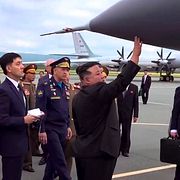
Kim Jong-Un on aircraft inspection in Russia on Saturday. AP
Kim has looked at super robot and nuclear warplanes
North Korean dictator Kim Jong-Un has, during a visit to Russian Knevichi, looked at warplanes that can carry nuclear weapons and the super-fast hypersonic robot Kinzhal, reports Reuters.
The visit, which took place on Saturday, took place in the company of Vladimir Putin's Defense Minister Sergei Shoigu.
- They (the planes) can fly from Moscow to Japan and then back again, Shoigu said of one of the models.
Kim reportedly asked how to launch robots from the plane. A Russian representative told that the aircraft models are one of the important parts of Russia's nuclear forces.
Kim Jong-Un has been visiting Russia since September 12. Among other things, he has met Vladimir Putin to discuss military issues, the war in Ukraine and how the countries could deepen their cooperation.
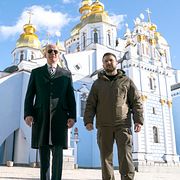
Biden visiting Kyiv earlier this year. Evan Vucci/AP
The Russian invasion. The outside world's response
Analysis: Zelenskyj can end Biden's nightmare
The president of the United States has had a tough week with impeachment threats from Republicans, the biggest strike in the auto industry in years and, to top it all off, his advanced age continues to be questioned.
"A week that Joe Biden would rather forget," writes DN's Karin Eriksson in her analysis.
The strike in the car industry means that Biden now has to walk a difficult balancing act, says Eriksson. The president wants to show that he supports the unions while knowing that the strike could have serious consequences for the economy and the green transition.
Bloomberg's Justin Sink and Ana Monteiro describe the strike as the crowning achievement of a week filled with political suffering.
"Biden needs to recover quickly," they write.
They see next week's meeting with Ukraine's Volodymyr Zelensky as a golden opportunity for a political victory for the US president.
The hope from the White House is that the presidents will be able to charm the Republicans on their side, and thus secure a new large aid package for Ukraine.
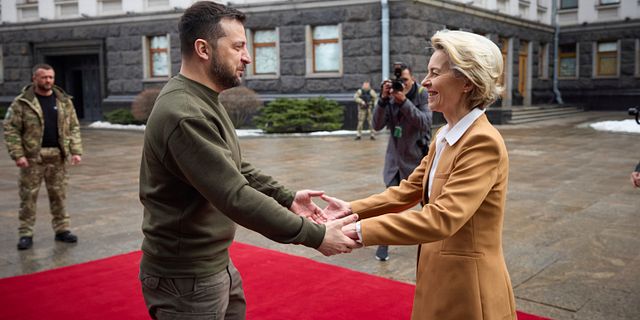
Ukrainian President Volodymyr Zelenskyy and European Commission President Ursula von der Leyen. AP
The Russian invasion|The future of the EU
Analysis: EU wants to expand before Putin takes more land
It is clear that the decision-makers in Brussels view an enlargement of the EU differently than they did before the full-scale Russian invasion of Ukraine, write Nora Siklodi and Nándor Révész in an analysis in The Conversation.
The fact that the President of the European Commission, Ursula von der Leyen, recently gave her clearest and most positive statement so far about enlargement must be seen as a sign that the EU's economic and legal role is no longer being emphasized, but also its more unifying task.
"Including more member states is no longer just a distant dream but a prominent and current goal," write Siklodi and Révész.
In an analytical article on Politico's EU site, Suzanne Lynch and Nicholas Vinocur write that the EU does not feel it can afford to wait to incorporate Ukraine, Moldova and several countries in the Balkans into the Union. The reason is Vladimir Putin's war of invasion.
But rushing forward with decisions about new member states can have troublesome consequences, say Lynch and Vinocur. Among other things, it can result in "infected internal quarrels between current member states".

Inga kommentarer:
Skicka en kommentar