Europe's green parties face a difficult dilemma
Wolfgang Hansson
Published: Less than 3 hours ago
This is a commenting text. Analysis and positions are the writer's.
COLUMNISTS
Should one adapt to a grim reality or continue to hide behind ideological blinders?
Green parties in Germany, Sweden and the rest of Europe face a difficult dilemma.
In Germany, they are now hugging nuclear power under the gallows. But only temporarily.
The Green Party's existence in Germany is intimately linked with their staunch opposition to nuclear power. No environmental party in Europe has fought so hard against nuclear power, succeeded and grown strongly. Since 2011, Germany has phased out all nuclear power. Today, only three reactors remain.
So it must have been bitter medicine to swallow for the environmentalist economy minister Robert Habeck when he was forced to extend the life of two of Germany's remaining nuclear power plants.
Restarting shut down coal power plants seems to have been only half as hard.
In order to at least to some extent save the reputation of the party, the German government was content to merely extend the operation until the end of March. In addition, the reactors must only be used in an emergency.
Something that immediately encountered strong criticism not only from the opposition but also internally within the government where the Liberal Democrats want to let the existing reactors run until Germany has had time to replace more of the Russian gas with other energy sources.
Many therefore believe that the decision will be reconsidered again if electricity prices rush to levels no one can pay.
Ska man anpassa sig efter en bister verklighet eller fortsätta gömma sig bakom ideologiska skygglappar?
Gröna partier i Tyskland, Sverige och övriga Europa står inför ett svårt dilemma.
I Tyskland kramar man nu kärnkraften under galgen. Men bara tillfälligt.
Partiet
De Grönas existens i Tyskland är intimt sammanknutet med deras benhårda
motstånd till kärnkraft. Inget miljöparti i Europa
har kämpat så hårt mot kärnkraften, lyckats och vuxit sig starkt.
Tyskland har sedan 2011 avvecklat all kärnkraft. I dag finns bara tre
reaktorer kvar.
Därför
måste det ha varit en bitter medicin att svälja för den
miljöpartistiske ekonomiministern Robert Habeck när han tvingades
förlänga livslängden för två av de återstående kärnkraftverken i
Tyskland.
Att återstarta avställda kolkraftverk verkar bara ha varit hälften så jobbigt.
För
att åtminstone i någon mån rädda partiets anseende nöjde sig den tyska
regeringen med att bara förlänga driften fram till slutet av mars.
Reaktorerna ska dessutom bara användas i nödfall.
Sacrifices
Nuclear power currently accounts for six percent of German electricity consumption. In a situation where Russia has shut off the gas in the Nordstream 1 line, it puts Germany in front of an energy crisis this winter. The population has already been asked to make great sacrifices in attempts to save electricity. Swimming pools are closed, the temperature is lowered in public buildings, the hot water is turned off and a series of other far-reaching measures.
Then it appears as a strange risk-taking that Germany refrains from using all the electricity it can produce, including nuclear power. The impression is that the Greens' ideological opposition to nuclear power is prioritized over Germany's urgent need for energy this winter.
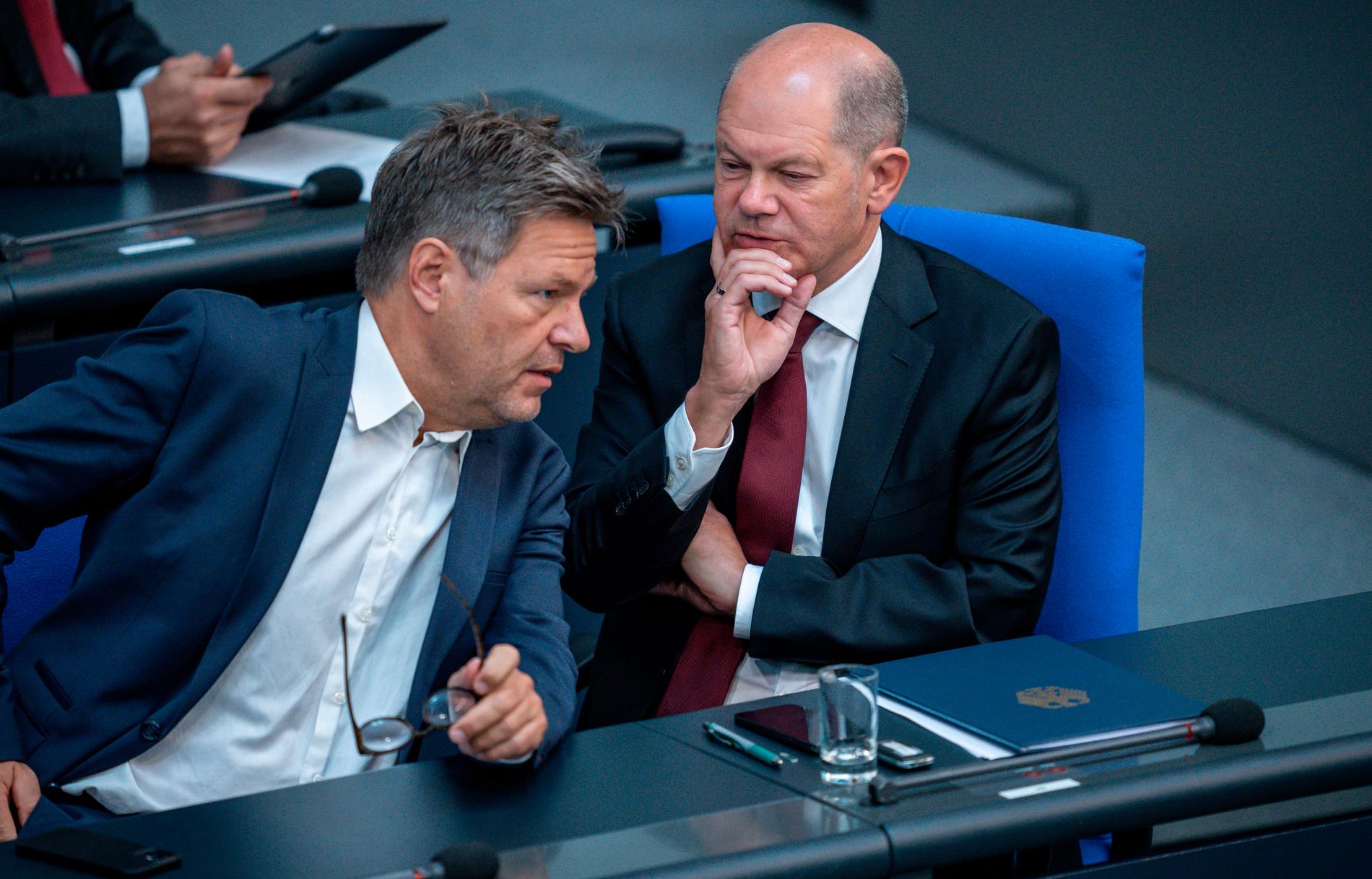
Robert Habeck and Chancellor Olaf Scholz. Photo: Michael Kappeler / AP
It might save Habeck's reputation for the time being within the party, but the risk is that the Greens will become a scapegoat if there is a tough winter and the electricity is not enough.
The Greens in Germany are not alone in their dilemma.
While they are facing an acute crisis of confidence, the Green Party in Sweden is constantly forced to defend that four reactors have been shut down in Oskarshamn and Ringhals in recent years, which has reduced access to planable energy in southern Sweden.
Opinion fluctuates
For the party it felt like an important success when it started, but now it does not appear as brilliant. When one penetrates all the fog curtains that both sides are trying to put out in the election campaign, it cannot be denied that the situation for Sweden's energy supply, and to some extent Europe's, would have looked better if the reactors were still in operation.
The acute energy crisis in Europe and the galloping electricity prices have caused public opinion to swing against nuclear power.
Many are still against building new nuclear power, but at the same time see it as an unreasonable strategy to close already existing reactors that could be operated further.
Although Angela Merkel's decision in 2011 to shut down all nuclear power and instead become more dependent on Russian gas in retrospect appears to be a gross misjudgment, the shutdown has had the good thing that Germany has greatly expanded renewable energy such as wind and solar.
The problem is that both wind and solar are highly weather dependent and not as reliable as nuclear power. No matter how much you expand them, they do not provide a stable electricity grid as long as sun and wind cannot be stored for a longer period of time.
Renewable energy and nuclear power complement each other.
Finnish turnaround
Finland's Environmental Party has solved the dilemma by simply supporting nuclear power as an energy source.
The total conversion came earlier this year after Russia invaded Ukraine. The fact that Finland borders Russia means that the greens there more clearly feel on the surface that there is a strong security policy dimension in energy policy.
Nuclear power is not an ideal energy source. The Three Mile Island, Chernobyl and Fukushima accidents all had extremely serious consequences. On top of that, uranium must be mined and the waste stored for 100,000 years.
Against this is the fact that the world must urgently change to reduce the climate threat. Germany's energy mix consists of 30 percent coal.
To then shut down fossil-free nuclear power, whose lifespan can be extended, appears contradictory at best.
Putin's energy war and Europe's acute electricity crisis make it even more difficult to justify even for environmental parties.


Inga kommentarer:
Skicka en kommentar