
Wolfgang Hansson
Published: Very recently
This is a commenting text. Analysis and positions are the writer's.
COLUMNISTS
The headline of my column after the 2018 election read "Sweden has become like everyone else".
This year, it must be sharpened considerably. Sweden has become one of Europe's most extreme countries.
In no other Western European country does a far-right party have such a large share of the votes in parliament.
It is as if Sweden was only a few years behind in development. We have moved in slow motion while others have run ahead, believing that if we just try to freeze out the right-wing populists, they will disappear.
In Austria, the far-right FPÖ was in government as early as 1999. At the time, it was something unheard of. The entire rest of the EU turned as one man against the coalition. A total diplomatic boycott was directed for six months against the government in Vienna.
During the same period, right-wing extremism barely existed in Sweden. In the 2002 parliamentary election, SD received 1.4 percent.
But a far-right wave has rolled over the rest of Europe like an avalanche. Hungarian Fidesz and Polish PIS are in a class of their own. In Western Europe, the Italian party Lega received just over 17 percent in the last parliamentary election. The same as the Austrian FPÖ and Marine Le Pen's National Assembly in France.
But now they are being beaten by SD, which looks set to end up above 20 percent.
When the Norwegian Progressive Party became the largest bourgeois party in the Storting in 2005, Sweden was horrified. The same when the Danish People's Party became a support group for the bourgeois government there. Finland was a bit more cautious, but the True Finns have already managed to sit in the government.
We regarded our Nordic neighbors as pariahs.
But it didn't take long before the roles were reversed. After the wave of immigration in 2015 and the explosion of gang crime and shootings, it is the other Nordic countries that are appalled by "the Swedish state of affairs". An affliction where the road, according to them, only leads in one direction; against chaos and decay.
Country after country in Europe has seen great success for right-wing populist or far-right parties, whichever epithet one applies to them. For a long time, Sweden was seen by Swedes and many others as an impregnable bastion of tolerance and humanity. Proof that the compassionate welfare society could survive in a world of Trump, Marine Le Pen, Matteo Salvini and Geert Wilders.
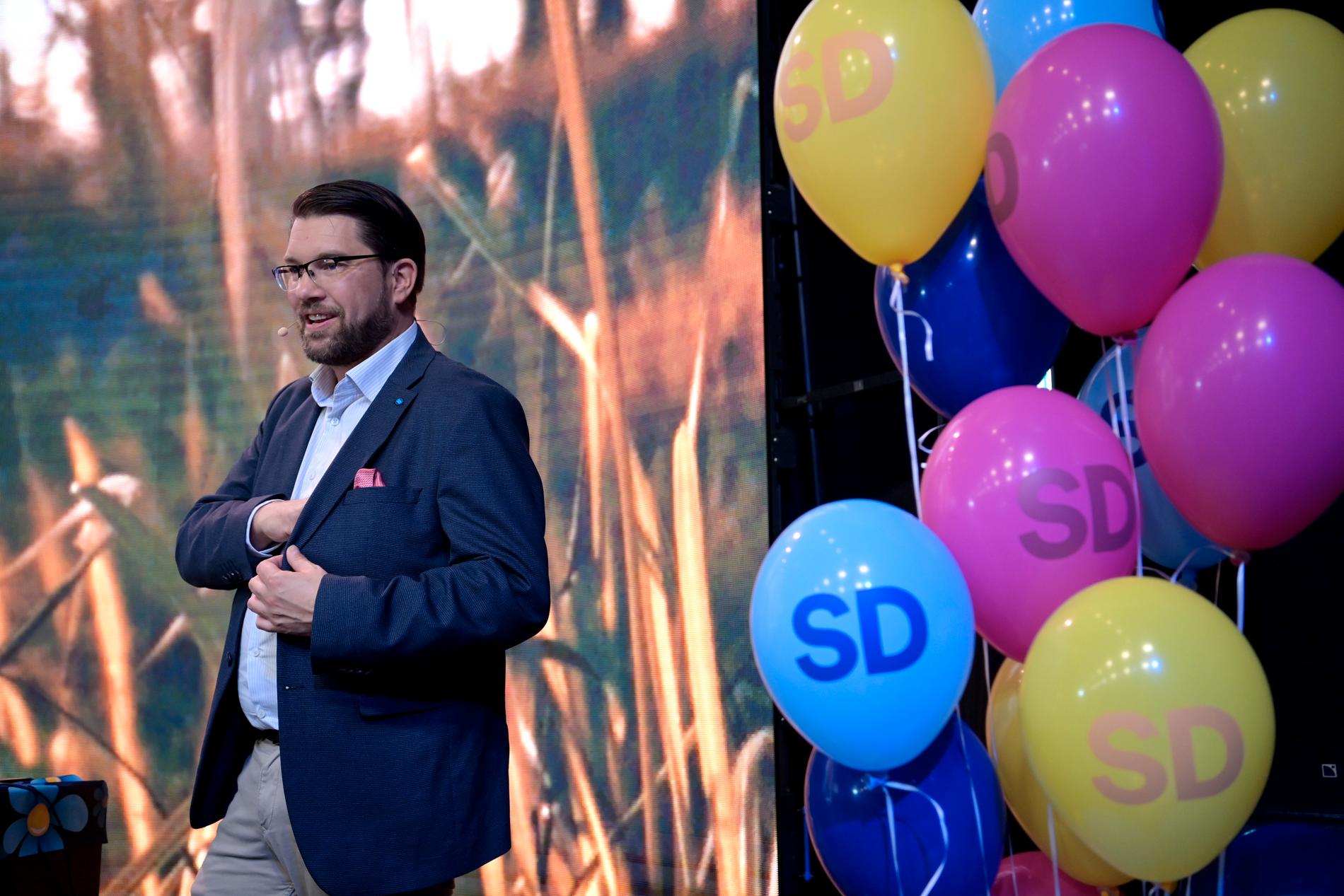
Jimmie Åkesson during SD's election vigil. Photo: JERKER IVARSSON
As early as the 2018 election, that image was substantially corrected. SD received 17.5 percent of the vote. But still none of the other parties wanted to take them with forceps. A border that has long since been crossed in all European countries, except Germany.
After this year's election, it is enough to state that Sweden now belongs to the most extreme countries in Europe. Apart from parts of Eastern Europe, the extreme right is not that strong elsewhere.
Even if Jimmie Åkesson would have no influence over the coming government, we are now a country that is forced to look at itself for a new self-image. That rose-shimmering idyll of Bullerbyn, the people's home, no longer exists.
Many Swedes have realized that, but abroad the image of the perfect and prosperous Sweden still lives on.
Now foreign commentators and journalists triumphantly point out that even the Swedes have been forced to realize that we are not as good and tolerant as we imagined.
Danish Ekstrabladet proclaims that finally "the token has fallen".
This is how Hans Petter Sjöli comments in the Norwegian newspaper VG.
- Where previously you got the racist stamp engraved on your forehead if you hinted at problems with, for example, social segregation along ethnic lines, now Prime Minister Magdalena Andersson herself uses expressions like "Somalitown". That's how you have to rub your eyes.
He believes that reality caught up with the Swedes during the refugee crisis in 2015/16.
- The Sweden Democrats have won the battle for the story of our time's "people's home" - a rickety structure, set up without adequate floor plans or plans for necessary maintenance.
German newspapers point out, not without some glee, that the SD is a party with Nazi roots, while the German right-wing extremists AfD were founded by a group of economists who were dissatisfied with the EU. Nevertheless, all the major German parties have so far kept the crude march to the right. No cooperation with AfD.
It has worked because in Germany they succeeded in working across bloc borders. At first it was the Social Democrats and the Christian Democrats who governed together. Now the government consists of the Social Democrats, the Greens and the Liberal Democrats.
Mathematically, such cross-block constellations could keep SD away from influence.
But despite the fact that Sweden is in many ways in a state of crisis, it seems like a utopia that something similar would happen here. A government consisting of, for example, S+M+C is only possible on paper.
At the same time, the Danish newspaper Berlingske poses a highly relevant question in its first election analysis.
"SD has over 1.5 million Swedes behind it. The question is how long the Social Democrats can afford to demonize such a large group of Swedes who vote for a democratic party."
Maybe the train has already left.

Inga kommentarer:
Skicka en kommentar