
Columnists
Inflation
Don't be fooled – inflation is not over
Andreas Cervenka
Reporter and economic commentator
This is a commenting text. Analysis and positions are the writer's.
Published 16.45
What we are experiencing is a persistent hangover after over ten years of intoxicatingly low interest rates.
The worst price shocks are about to subside, but inflation will continue to plague Swedes in 2024 as well.
This summer the interest rate will be lowered.
But save the champagne – there is a flip side.
Few, if any, authorities have the same immediate impact on people's everyday lives as the Riksbank. In loan-loving Sweden, there are many who now sit as if on pins and needles every time interest rate announcements and inflation figures are announced.
It's just sad that the country's most powerful authority is also the one that perhaps has the biggest problem with credibility.
The basic tip for an ordinary citizen trying to orient himself about the future of the economy: Whatever you do, don't trust the Riksbank.
Just over two years ago, in November 2021, the Riksbank predicted that the interest rate in 2024 would be 0. As you know, it is 4 percent. In its latest forecast from November of last year, the Riksbank predicted that this interest rate will hold until 2025.
They are very alone in believing that.
Bank economists are now talking about a first interest rate cut already in May and that the interest rate in 2025 will be around 2.5 percent.
The reason is that inflation continues to fall. Monday's figures from Statistics Norway showed that the CPIF inflation measure in December fell to 2.3 percent, the lowest level since 2021 and close to the Riksbank's target of 2 percent.
Hooray, danger over!
Unfortunately, it's not quite that simple. The term inflation is tricky and there are so many different abbreviations and definitions circulating that even an economist can get a headache.
This summer, the interest rate is expected to be lowered. Photo: Tim Aro/TT
To begin with, the figure generally referred to as inflation is actually the inflation rate, i.e. how much prices change during a month compared to the same month a year earlier.
In December 2022, electricity prices were at a record high. In December 2023, they were as much as 39 percent lower, and that reduced inflation by 2.3 percentage points, according to Statistics Norway. That's a lot. But since the electricity prices have jumped so far during January 2024, it seems to turn the other way when the figures are released in a month's time.
CPIF is, according to the Riksbank, the most important inflation measure.
It's no coincidence. Namely, the effects of the authority's decision are excluded there. They simply pretend that the rampant mortgage interest rates that have affected millions of Swedes in the past two years never happened.
It is quite misleading, because the interest rates in particular dig a very deep hole in many people's finances. In the broadest and actually most relevant measure, the CPI, interest rate increases are included in the calculations. Then inflation was suddenly not 2.3 percent in December but 4.4 percent.
Although it was down from 5.8 percent in November, it is still very high, you have to go back to 1993 to find similar numbers.
Higher interest rates contributed 2.2 percentage points to the CPI increase in December. Half of the real inflation that hits households is thus created by the Riksbank itself.
Another way of expressing inflation is CPIF-XE where, in addition to interest rates, the fluctuating energy prices are also excluded.
Sweden's GDP decreased in 2023 and is expected to decrease this year as well. Photo: Fredrik Sandberg/TT
It is also usually referred to as "underlying inflation". By that measure, the increase was 5.3 percent in December. Declaring the death of inflation is therefore a bit early.
And remember: reduced inflation is not the same as the fact that the often rather reckless price increases of recent years will be withdrawn and prices will fall - only that they will continue to rise at a slightly slower pace.
During 2022 and 2023, the CPI rose by a total of 18 percent. It is an incredibly rapid weakening of the purchasing power of our money.
The Riksbank predicts that the CPI will increase by 4.4 percent throughout 2024.
In its latest forecast, the government also believes in a CPI increase of close to 4 percent.
As I said, the Riksbank will likely be wrong and other economists believe in lower CPI inflation, but it is clear that even during large parts of 2024 we will see price increases at clearly higher levels than we have been used to for a long time.
However, the worst is behind us, and when interest rates are likely to be lowered later this year, it will be a relief for many.
But it's also important to remember why inflation is falling: the economy is tanking. Most banks predict that Sweden's GDP will decline in 2023 and that there will also be negative figures for 2024. Two years in a row with shrinking GDP has only occurred twice since the Second World War, in the 1990s and in 2008/2009.
We can talk about a real turnaround in 2025 at the earliest.
What we are experiencing is a persistent hangover after over ten years of intoxicatingly low interest rates.
The Riksbank has a heavy responsibility with its minus interest rate and excess stimulus, not least during the pandemic when Sweden was drowned in newly printed money. In retrospect, it turned out to be as smart as air-bombing a forest fire with gasoline.
But we won't get any excuse from them. On the contrary.
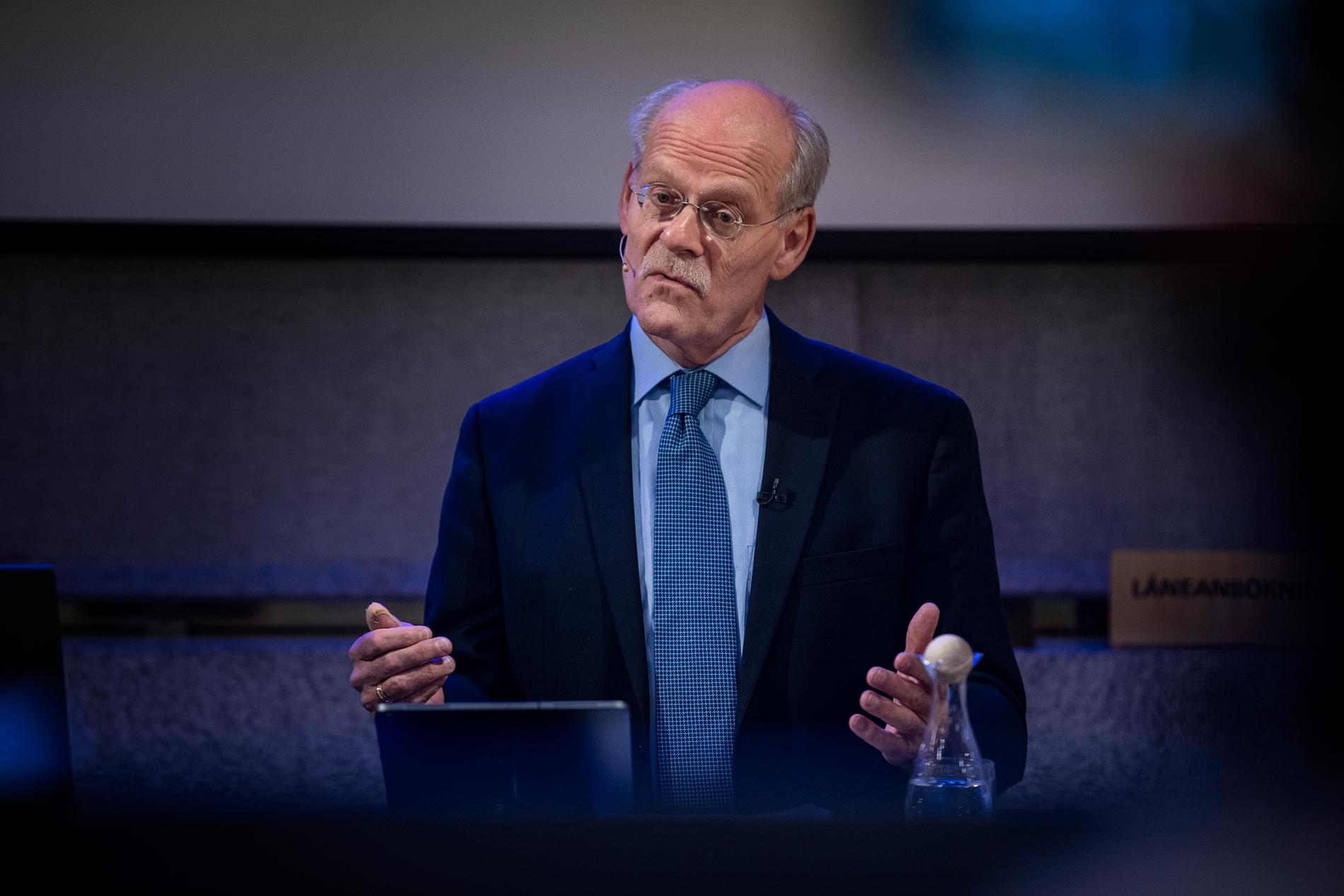
Stefan Ingves. Photo: Jerker Ivarsson
Former Riksbank governor Stefan Ingves recently explained in an interview with DITV that he has no regrets and seems to think that the authority basically did everything right.
Neither do the politicians take responsibility for the fact that the Swedes are one of the countries in Europe that have been hit hardest by the inflation crisis.
The situation in the Swedish economy can thus be summarized as follows: Nobody did anything wrong, yet so much went wrong.
This is what breeds populism.

Inga kommentarer:
Skicka en kommentar