Därför är Natos fokus framåt inte Ryssland
Nato-debatten är av naturliga skäl fokuserad på här och nu. Men det finns anledning att lyfta blicken.
Det är rimligen så att en säkerhetspolitisk linje som Sverige hållit i uppåt 200 år inte ska överges lättvindigt, men det är egentligen en bisak.
Poängen är att den nya gärna ska hålla väldigt många år framåt.
Och hur ser världen ut då?
Ryssland är strukturellt på dekis.
Befolkningen sjunker. FN räknar med att ryssarna är 135 miljoner 2050, sju procent färre än idag.
Det är egentligen värre än det ser ut. Ett dramatiskt fall i antal födslar under 1990-talet gör att det är ungdomarna, de som nu borde komma in på arbetsmarknaden, som inte finns.
Antalet sysselsatta 2030 beräknas vara 7 miljoner färre (65,5 miljoner personer) än antalet 2015.
Allt färre yngre måste försörja allt fler äldre.
Ryssland är redan nu en liten ekonomi, mindre än Italien, en dvärg jämfört med EU och ingenting tyder på att det kommer vända.
Landet står för 1,7 procent av världens BNP – Italien, Frankrike, Storbritannien och Tyskland står för 13,2.
Ryssland är svårt råvaruberoende och dess viktigaste exportvaror – olja och gas – vill ingen längre ha, dels för att de är olja och gas, dels för att de kommer från Ryssland.
Nu har landet dessutom gjort sig till internationell paria, med svåröverblickbara konsekvenser.
Ryssland har rustat kraftigt i över ett decennium, men har hittills ändå haft betydande problem med att efter en lång förberedelse landvägen invadera ett grannland.
Takten i den ryska upprustningen kan svårligen upprätthållas över tid. Militärutgifterna som andel av BNP har sjunkit efter 2016.
Samtidigt rustar nästan alla EU-länder nu upp sina försvar. Tyskland tänker göra sig till en militär makt att räkna med igen.
Ryssland är relativt sett som starkast just nu. Europas kollektiva förmåga kommer att växa för var dag som går.
Ryssarna har fortfarande kärnvapen och betydande militära styrkor. De kommer med nuvarande ledning att vara en källa till oro och problem under överskådlig tid.
Men är det självklart att Ryssland om 10, 15 eller 20 år utgör ett militärt hot mot något EU-land?
Fråga vilken svensk som helst, och hen kommer att svara ungefär samma sak: Vi går med i Nato för att få skydd mot Ryssland.
Men för Natos tongivande länder är krisen i Östeuropa redan en sidoföreställning.
Barack Obamas omtalade ”svängning mot Asien” har över 10 år på nacken, och USA har betraktat Kina som sin huvudsakliga geopolitiska motståndare längre än så.
Säkerhetspakten Aukus mellan USA, Storbritannien och Australien bildades för ett halvår sen.
Internationellt diskuteras, mitt under brinnande krig, hur Europas försvarsmakter ska kunna hjälpa till i ett krig om Taiwan.
Det behöver förstås inte vara ett problem för Nato-linjen.
Det går alldeles utmärkt att argumentera för att Sverige av en rad olika skäl lojalt ska sluta upp bakom den ena av två supermakter i en storkonflikt på andra sidan jordklotet, och om USA angrips först kanske till och med skicka stridsflygplan och soldater för att utkämpa tredje världskriget om Spratly-öarna.
Men i det tempo som Nato-anslutningen nu verkar ske är det knappast en möjlig utveckling som svenskarna ännu haft en reell chans att ta ställning till.
..................................................
Niclas Vent
Therefore, NATO's focus forward is not Russia
Published: Less than 20 minutes ago
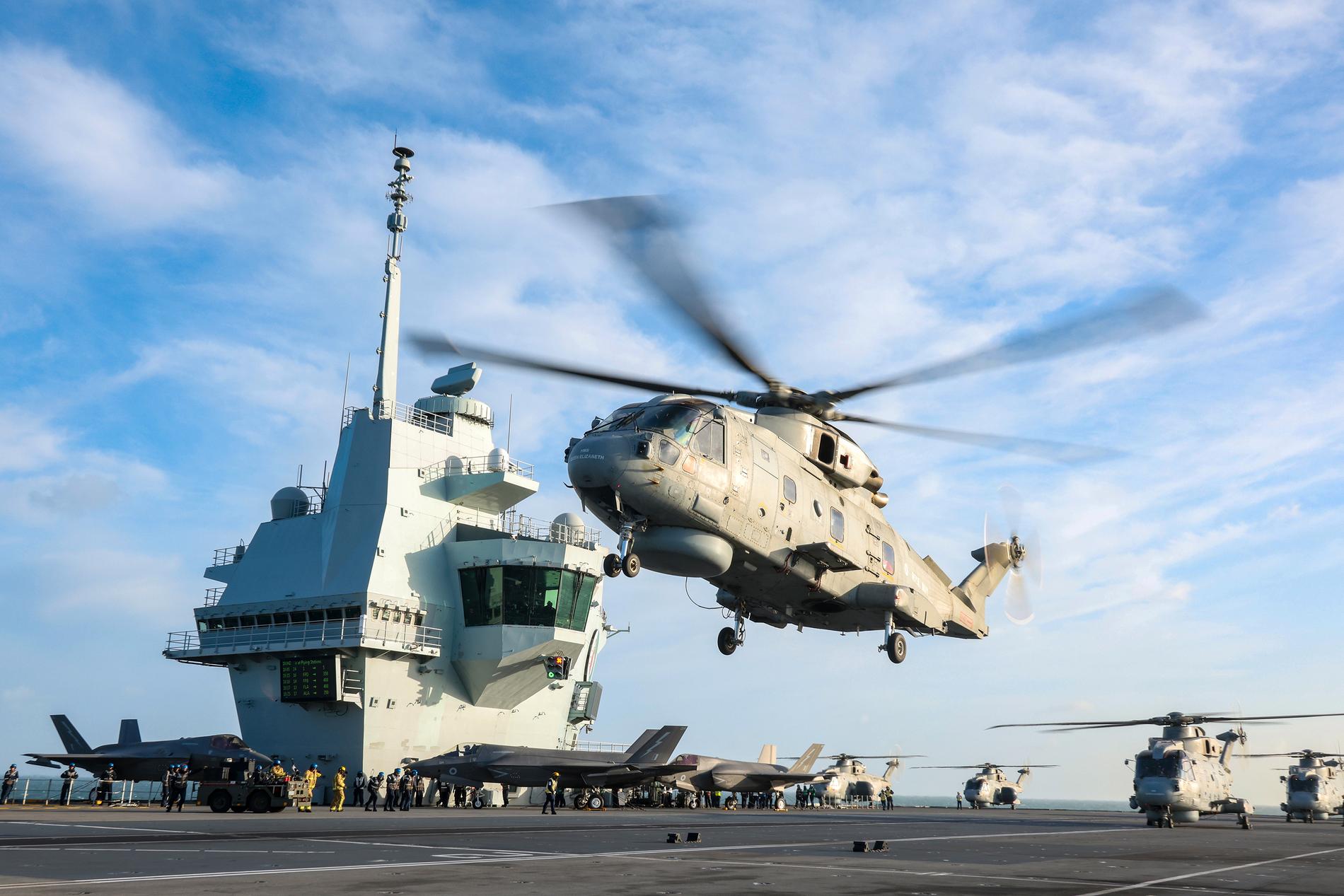
En Merlin-helikopter lyfter från flygdäcket på HMS Queen Elisabeth, den ena av Storbritanniens två nya, stora hangarfartyg. Storbritannien är ett av de tongivande Natoländer som lyft fram Kina som den viktigaste aktören i den globala stormaktskonkurrensen. ”Det är tydligt att Storbritannien betraktar Kina inte bara som en konkurrent, utan som ett hot,” skriver FOI i en rapport.
NEWS
A Merlin helicopter takes off from the deck of HMS Queen Elisabeth, one of the UK's two new large aircraft carriers.
Britain is one of the leading NATO countries, highlighting China as the most important player in the global great power competition.
"It is clear that Britain sees China not only as a competitor, but as a threat," FOI wrote in a report.
A Merlin helicopter takes off from the deck of HMS Queen Elisabeth, one of the UK's two new large aircraft carriers. Britain is one of the leading NATO countries, highlighting China as the most important player in the global great power competition. "It is clear that Britain sees China not only as a competitor, but as a threat," FOI wrote in a report. Photo: Jay Allen / Royal Navy NEWS
The NATO debate is naturally focused on the here and now.
But there is reason to look up.
It is reasonable that a security policy line that Sweden has maintained for upwards of 200 years should not be abandoned lightly, but it is really a side issue.
The point is that the new one should last for many years to come.
And what does the world look like then?
Russia is structurally on ice.
The population is declining.
The UN estimates that the Russians will be 135 million by 2050, seven percent fewer than today.
It's really worse than it looks. A dramatic fall in the number of births during the 1990s means that it is the young people, those who should now enter the labor market, who do not exist.
The number of employed in 2030 is estimated to be 7 million fewer (65.5 million people) than the number in 2015. Fewer and fewer young people have to support more and more older people.
Russia is already a small economy, smaller than Italy, a dwarf compared to the EU and there is no indication that it will turn around.
The country accounts for 1.7 percent of world GDP - Italy, France, the United Kingdom and Germany account for 13.2.
Russia is heavily dependent on raw materials and its most important export goods - oil and gas - no one wants anymore, partly because they are oil and gas, partly because they come from Russia.
Now the country has also made itself an international pariah, with difficult consequences for the foreseeable future.
Russia has been heavily equipped for over a decade, but has so far had significant problems with invading a neighboring country by road after a long preparation.
The pace of Russian rearmament can hardly be maintained over time. Military expenditure as a share of GDP has fallen since 2016.
At the same time, almost all EU countries are now arming their defenses. Germany intends to make itself a military power to be reckoned with again.
Russia is relatively the strongest right now. Europe's collective capacity will grow with each passing day.
The Russians still have nuclear weapons and significant military forces. With the current management, they will be a source of concern and problems for the foreseeable future.
But is it obvious that in 10, 15 or 20 years' time Russia will pose a military threat to any EU country?
Ask any Swede, and he will answer about the same thing: We join NATO to get protection against Russia.
But for NATO's leading countries, the crisis in Eastern Europe is already a side-effect.
Barack Obama's famous "swing towards Asia" has been around for over 10 years, and the United States has regarded China as its main geopolitical opponent for longer than that.
The Aukus Security Pact between the United States, the United Kingdom and Australia was formed six months ago.
Internationally, in the midst of a burning war, there is a discussion about how Europe's defense forces can help in a war over Taiwan.
Of course, this does not have to be a problem for the NATO line.
It is perfectly possible to argue that Sweden, for a number of different reasons, should loyally end up behind one of two superpowers in a major conflict on the other side of the globe, and if the United States is attacked first, maybe even send fighter jets and soldiers to fight World War III about the Spratly Islands.
But at the pace at which NATO accession now seems to be taking place, it is hardly a possible development that the Swedes have yet had a real chance to take a stand on.

Inga kommentarer:
Skicka en kommentar