Niclas Vent
Therefore, NATO's focus forward is not Russia
PUBLISHED: LESS THAN 1 HOUR AGE
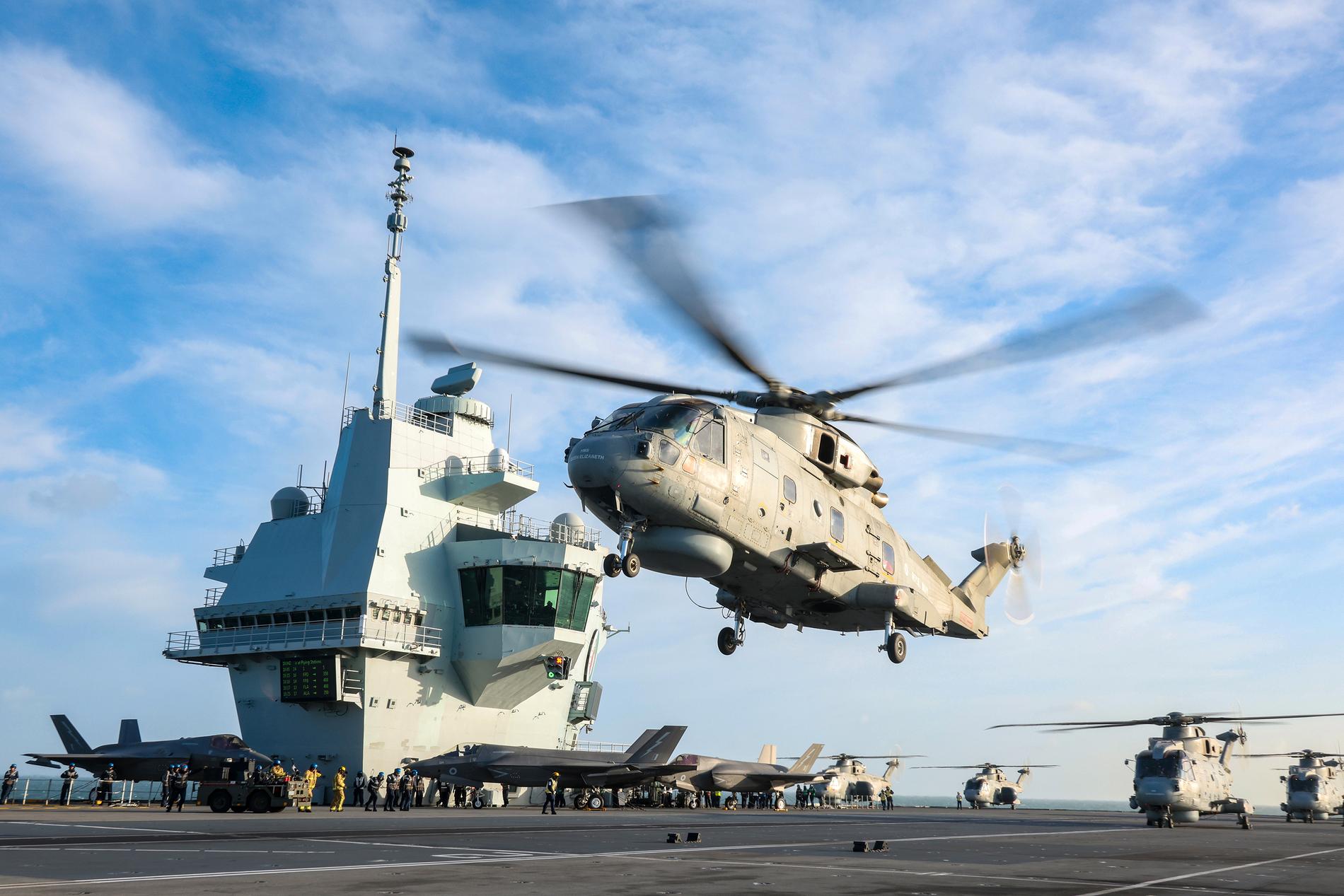
A Merlin helicopter takes off from the deck of HMS Queen Elisabeth, one of the UK's two new large aircraft carriers. Britain is one of the leading NATO countries, highlighting China as the most important player in the global great power competition. "It is clear that Britain sees China not only as a competitor, but as a threat," FOI wrote in a report.
A Merlin helicopter takes off from the deck of HMS Queen Elisabeth, one of the UK's two new large aircraft carriers. Britain is one of the leading NATO countries, highlighting China as the most important player in the global great power competition. "It is clear that Britain sees China not only as a competitor, but as a threat," FOI wrote in a report.
Photo: Jay Allen / Royal Navy
NEWS
The NATO debate is naturally focused on the here and now. But there is reason to look up.
It is reasonable that a security policy line that Sweden has maintained for upwards of 200 years should not be abandoned lightly, but it is really a side issue.
The point is that the new one should last for many years to come.
And what does the world look like then?
Russia is structurally on ice.
The population is declining. The UN estimates that the Russians will be 135 million by 2050, seven percent fewer than today.
It's really worse than it looks. A dramatic fall in the number of births during the 1990s means that it is the young people, those who should now enter the labor market, who do not exist.
The number of employed in 2030 is estimated to be 7 million fewer (65.5 million people) than the number in 2015.
Fewer and fewer young people have to support more and more older people.
Russia is already a small economy, smaller than Italy, a dwarf compared to the EU and there is no indication that it will turn around.
The country accounts for 1.7 percent of world GDP - Italy, France, the United Kingdom and Germany account for 13.2.
Russia is heavily dependent on raw materials and its most important export goods - oil and gas - no one wants anymore, partly because they are oil and gas, partly because they come from Russia.
Now the country has also made itself an international pariah, with difficult consequences for the foreseeable future.
Russia has been heavily equipped for over a decade, but has so far had significant problems with invading a neighboring country by road after a long preparation.
The pace of Russian rearmament can hardly be maintained over time. Military expenditure as a share of GDP has fallen since 2016.
At the same time, almost all EU countries are now arming their defenses. Germany intends to make itself a military power to be reckoned with again.
Russia is relatively the strongest right now. Europe's collective capacity will grow with each passing day.
The Russians still have nuclear weapons and significant military forces. With the current management, they will be a source of concern and problems for the foreseeable future.
But is it obvious that in 10, 15 or 20 years' time Russia will pose a military threat to any EU country?
Ask any Swede, and he will answer about the same thing: We join NATO to get protection against Russia.
But for NATO's leading countries, the crisis in Eastern Europe is already a side-effect.
Barack Obama's famous "swing towards Asia" has been around for over 10 years, and the United States has regarded China as its main geopolitical opponent for longer than that.
The Aukus Security Pact between the United States, the United Kingdom and Australia was formed six months ago.
Internationally, in the midst of a burning war, there is a discussion about how Europe's defense forces can help in a war over Taiwan.
Of course, this does not have to be a problem for the NATO line.
It is perfectly possible to argue that Sweden, for a number of different reasons, should loyally end up behind one of two superpowers in a major conflict on the other side of the globe, and if the United States is attacked first, maybe even send fighter jets and soldiers to fight World War III about the Spratly Islands.
But at the pace at which NATO accession now seems to be taking place, it is hardly a possible development that the Swedes have yet had a real chance to take a stand on.
Of:
Niclas Vent
PUBLISHED:
PUBLISHED: 18 APRIL 2022 KL. 21.44
AFTONBLADET

Inga kommentarer:
Skicka en kommentar