
Queen Elizabeth II is dead
Of:
Jenny Alexandersson
Published: Less than 10 min ago
Elizabeth II
Queen Elizabeth II is dead.
An era is over.
A whole world is in mourning.
The Queen of Great Britain and the Commonwealth fell asleep surrounded by those closest to her today at Balmoral Castle in Scotland.
The pulsating London has stopped for a moment.
As if a hack has created a crack in time.
Elizabeth II was a symbol of old and new Britain – a unifying force in a deeply divided world.
Her regency spanned from the early 1950s to the 2020s. The Berlin Wall had time to both be built and demolished. The Soviet Union collapsed, the Cold War ended. The queen saw new conflicts flare up across the world, burn and fall.
70 years of countless prime ministers, world wars, conflicts, conquests, the end of wars, technological developments, children and grandchildren and grandchildren's children.
An era is over and the world mourns.

Queen Elizabeth fell asleep with immediate family present at Balmoral castle in Scotland. Photo: Dominic Lipinski/AP
A growing mountain of flowers at the castle
The epicenter is London where the sadness can be seen in people's eyes. Thousands have gathered at Buckingham Palace to remember a beloved Queen.
You can see the sadness in the number of flowers that are placed on top of each other in a growing mountain at the castle gates.
The sadness can also be found in the headlines on the British newspaper pages, in the hushed chatter among the pub-goers and in the tears of the British over the cup of tea in front of the televisions. Sad music is played on the radio.
Queen Elizabeth was the longest reigning monarch on the British throne. In June, she celebrated her platinum anniversary. 70 years on the throne.
She became the country's oldest regent and probably the most loved and respected monarch.
Elizabeth II was the mother of the British nation and a stable point when politicians came and went, crises and disasters hit the country.
As head of the Commonwealth, she was also a symbol for 54 other countries. Although several states have left the Commonwealth over the years, respect for the Queen has remained.

Queen Elizabeth earlier in the summer. Photo: Royal Household/Ranald Mackechni
Life changed overnight
Elizabeth was never meant to be queen. It was her uncle Edward VIII who was the king of Great Britain.
But fate wanted otherwise.
When Edvard met the beautiful American actress Wallis Simpson, he fell head over heels.
Because Wallis Simpson was divorced twice, it was not an accepted royal marriage.
Edward chose love and on 11 December 1936 he abdicated the throne. Elizabeth's father Albert had to shoulder the responsibility as regent instead and Elizabeth's life changed forever.
Life was also turned upside down for Elizabeth's younger sister Margaret and her mother Elizabeth Bowes-Lyon.
Now it was serious.

Elizabeth with her father George VI. Photo: UNCREDITED / AP
Stayed when the bombs fell
Albert took the royal name George VI. He was well liked despite struggling with his confidence and suffering from poor health.
During World War II, the king showed how loyal he was to the country and the people. When the aerial bombs rained down on London, he refused to leave the city, even though there was a plan to rescue the royal family.
- The children don't leave London without me, I don't leave without the king and the king never leaves, said Elizabeth's mother.
That loyalty made a deep impression on Elizabeth. Serving the people and the country was above all else – even the king's own life and well-being. It later led to Elizabeth choosing to train as a driver and vehicle mechanic in the defense at the end of the Second World War. She also wanted to contribute.
It also led to the queen's own strong loyalty to the crown and the people. Year in and year out. Through both happy moments and crises.
Elizabeth's upbringing was characterized by preparations for the future role of queen. But it was never about any higher studies, Elizabeth was only taught between half past ten and eleven every morning. Afterwards, activities such as outdoor games, dancing and singing lessons were on the schedule.
When she got a little older and her father became king, the studies deepened somewhat. She read constitutional history and law with Henry Marten who was vice-provost at Eton College. She also received private lessons in religion from the Archbishop of Canterbury.

Elizabeth and the rest of the family when her father George VI was crowned king. Photo: Ap
Tragedies and betrayal in the family
Elizabeth was only 8 years old when she met her future husband Prince Philip for the first time. They met at the wedding of Princess Marina of Greece and Denmark and Prince George in 1934.
Five years later they saw each other again when Elizabeth accompanied her father on a visit to the Royal Naval College in Dartmouth. There, Philip was a student and Elizabeth immediately fell very much in love with the prince who was five years older. They were also distantly related.
Philip was born Prince Philippos of Greece on a dining room table in Corfu on 10 June 1921. His father was Prince Andreas of Greece and Denmark and his mother Princess Alice of Battenberg.
Prince Philip's aunt was Queen Louise of Sweden, married to Gustav VI Adolf. Philip was sixth in line to the Greek throne.
In other words, he was a blue-blooded and absolutely excellent future man for a British heir to the throne at a time when such things were very important.
Philip's childhood was marred by tragedy and betrayal. The family was forced into exile when the war between Greece and Turkey broke out. Philip's mother was committed to a mental hospital in Switzerland. The parents divorced and Philip's father had no place for the son in his life.
Philip was sent back and forth between relatives and the strict boarding school in Scotland.
It wasn't until he met Elizabeth that Philip got a real family and a home.
The Queen of Great Britain became the Prince's permanent safe point.
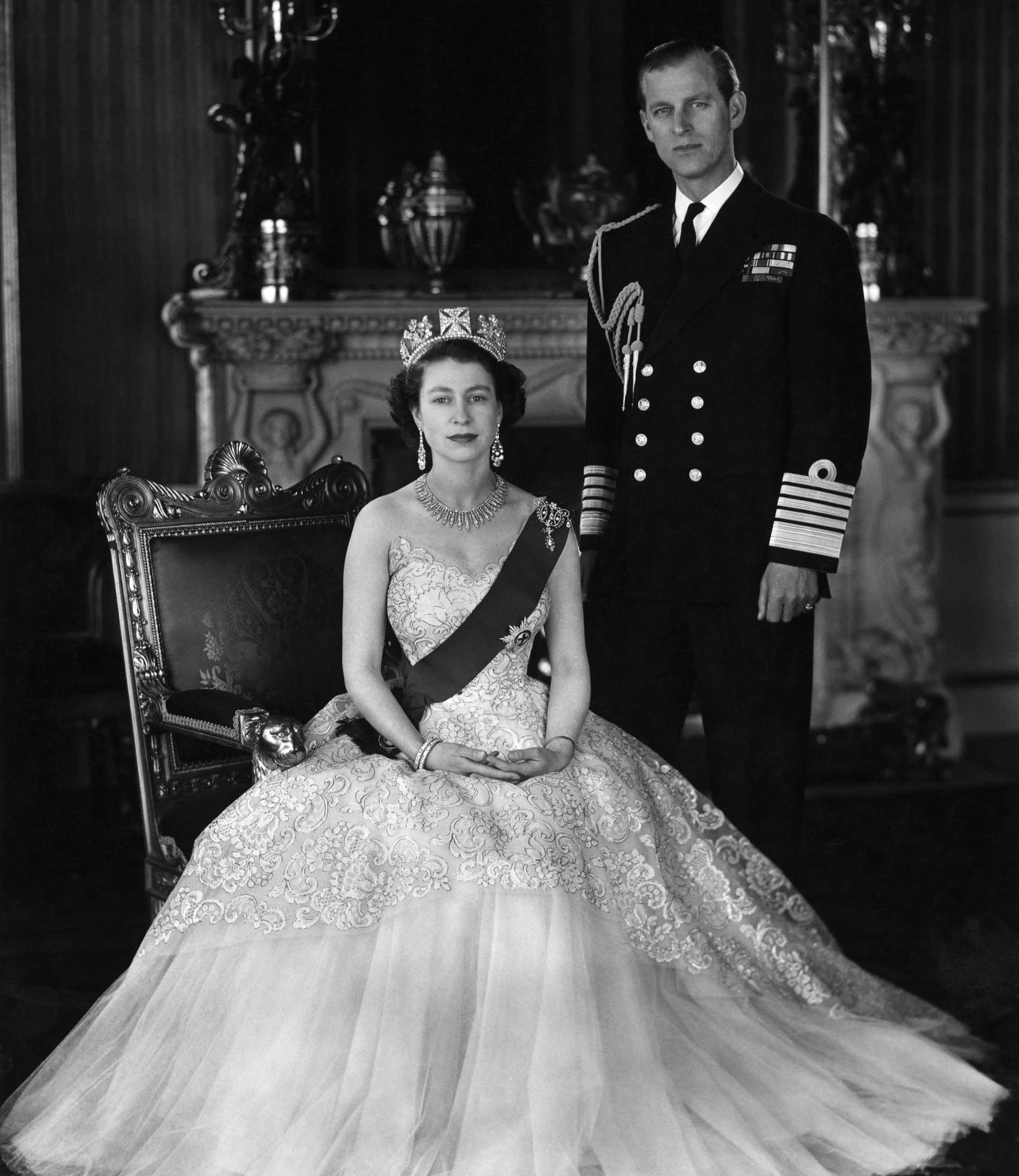
Queen Elizabeth and Prince Philip.
Queen Elizabeth and Prince Philip. Photo: Bettmann / Bettmann
Archive
A historic wedding
In 1947, Prince Philip proposed to Elizabeth and gave her an engagement ring made from stones from a tiara that had belonged to his mother.
On November 20, 1947, Elizabeth stepped through the gates of Westminster Abbey. The wedding was extraordinary and just as pompous as befits a queen-to-be.
It was the first ever royal wedding that could be followed by an entire world. 200 million people could hear Elizabeth's "yes" in the church via radio.
Time magazine wrote in its December 1947 issue: "The wedding swept across six continents and seven seas with a light so bright it was hard to take in.
"
The Second World War was over but in Britain there was a great shortage of goods. The Queen had to use ration coupons to get the silk, silk and lace for the dress.
Elizabeth was much admired, an idol to hundreds of thousands of young women. Young brides-to-be around the country gave away their ration coupons to her. But they quickly sent the court back because it was forbidden to give coupons away.
The tiara broke
The wedding day was anything but calm. Elizabeth looked collected, but just moments before the wedding her tiara had split in two. It was fixed temporarily.
And the day before, Prince Philip had been pulled over by police for speeding on his way to the evening's dinner. His only comment to the police is said to have been:
- I'm sorry Constable, but I have a meeting with the Archbishop of Canterbury.
The man who would marry them the next day.
Perhaps the dramatic start to the marriage was a reflection of what was to come. Because even though the two were head over heels in love with each other, the marriage was shaken both once and twice.
It was not always easy for Prince Philip that his wife stood above him in status and power. If Elizabeth ruled Britain, Philip wanted to rule at home anyway. He had the final say when it came to the family, which could lead to controversy.
But Elizabeth could always count on Prince Philip's support. He was there when it stormed as well as when the crown of his head weighed lightly.

Pictured from right: Prince Philip, Princess Anne, Prince Andrew and Prince Charles. Photo: AP TT NEWS AGENCY
Then the duty and responsibility became serious
Queen Elizabeth hoped to have many years with her family before the seriousness and duty of regent set in. She and Philip had four children together. In 1948 Charles was born, in 1950 Anne came, in 1960 Andrew and in 1964 the youngest Edward.
Elizabeth lived in Malta for the first time as a married woman. Prince Philip served in the Royal Navy and Elizabeth was almost like any military wife. Life was relatively free and relaxed, future duty somewhat distant.
But only five years after the wedding, Elizabeth received terrible news - her father was dead. She was 25 years old when she became Queen of the United Kingdom and the Commonwealth.
King George VI died of complications from lung cancer on 6 February 1952. He was found dead in his bed at Sandringham in Norfolk in the early hours of the morning.
Elizabeth was in Kenya when she received the death warrant. She and Prince Philip had checked into Sagana Lodge at the foot of beautiful Mount Kenya.
Philip was the one who delivered the death sentence.
Now the responsibility and duty were suddenly very real.

Picture taken in 1953 when Queen Elizabeth was crowned Queen. Photo: Ap
Diana revealed all
A year of mourning later, Elizabeth's coronation was held.
On June 2, 1953, the crown was placed on Elizabeth's head and 300 million television viewers could see the seriousness on her face.
When her uncle Edvard VIII abdicated in 1936, it shook the royal house to its foundations. It also affected Elizabeth deeply. It was the great scandal of the time and Elizabeth realized that every step, every decision, every thought and every moment of her life had to be dedicated to the royal house.
Therefore, her sister Margret was not allowed to marry her great love, the divorced lieutenant colonel Peter Townsend. Not without getting rid of the royal privileges.
It was also why the Queen forced Charles and Diana to divorce after Diana's shocking interview with the BBC in 1995. Then Diana revealed everything about Charles' infidelity with Camilla.
That's why she didn't visit Prince Charles at boarding school in Scotland when he was seriously ill with the Asian flu. She was already booked on a state visit to Canada.
Duty above all.
Even in front of love and family.
1992 became the queen's "annus horribilis". The terrible year. Three of her children's marriages ended and Windsor Castle burned.
Since the children grew up, the Queen had to deal with infidelity, divorce, crime, betrayal, accusations of racism and scandalous headlines over the years.
Through all trials, she has used the motto: "never complain, never explain". Never complain, explain nothing. Silence has been her defense as the British tabloids fill their pages with headlines.

Queen Elizabeth with Prince Philip and children Charles, Anne and Andrew. Photo: TT
Curious about ordinary people
15
Prime Ministers passed through Queen Elizabeth's audience room at
Buckingham Palace. The last one, Liz Truss, got to travel to Balmoral in
Scotland to meet the Queen. The Prime Ministers were always met by an
impeccably prepared Regent, with a number of initiated questions at the
ready.
It
is said that the Queen and Margaret Thatcher did not have very warm
feelings for each other. But Thatcher herself dismisses it in her
autobiography, saying that the Queen was always "correct" and that
"stories about two powerful women who collide are too good not to make
up".
Countless
presidents, foreign royalty, Nobel laureates and ambassadors have stood
by Queen Elizabeth's side at banquets and state visits.
Many of them are no longer alive today.
Yet it was the common man in whom the queen was most interested.
Children,
the elderly and the disabled always had a chance to shake her hand or
exchange a few words with her when she was out on a mission.
Elizabeth's privileged upbringing and life never stood in the way of meetings with ordinary people.
The
British royal family is conservative and much more traditional than
many others in Europe. But Queen Elizabeth was keen to keep up with the
times. Among other things, she became the first monarch to send an
e-mail. It happened back in 1976 and the message was sent from a British
military base via Arpanet which was an early precursor to the
internet.
Elizabeth delegated tasks to the entire family and allowed them to engage in current pressing issues.
She encouraged Princes William and Harry's work on mental illness and she supported Black Lives Matters.
 .
. Queen Elizabeth with her family on the Buckingham Palace balcony. Photo: Frank Augstein/AP
Walks and TV
evenings
Neighbors at Windsor were used to seeing the Queen in a tattered coat
and rain boots. When she rode her horses, she wore a shawl around her
head, never a riding helmet.
For
the queen, the longing for the everyday was palpable, especially during
the busiest working years. Elizabeth was one of the hardest working
regents and she had over 600 patronages on her list. At well over 90,
only daughter Anne still beat her in the number of official assignments
per year.
But when the queen came home in the evening, it was precisely the "ordinary" things she wanted to enjoy.
A dinner in front of the television together with Prince Philip was worth its weight in gold.
Or
a walk through the castle park with their beloved dogs. They always
kept her company. Over 30 corgis have pawed through the corridors of
Buckingham Palace. The queen has dedicated herself to breeding the
breed.
The Queen could never be "ordinary"
Over
the years, the dogs' names have caused the occasional Brit to raise an
eyebrow. Because how about Vulcan or Spick and Span?
Other little four-legged friends have been given names such as Brush, Windsor Spark, Windsor Myth and Pharos.
-
The dogs have been her safe point and friends in difficult times and
through sorrows and sorrows, says court expert Sara Ericsson.
Every
evening a Dry Martini was mixed for the Queen. Sometimes she took the
liberty of sipping on a Dubonnet and gin with ice and a slice of lime
instead. It was also her mother's favorite drink.
In October 2021, Elizabeth stopped drinking alcohol on the advice of her doctors.
But
Queen Elizabeth could never become "ordinary" herself. Every morning at
nine o'clock a bagpiper played outside her window. After that, the
Queen eats her breakfast, often British kipper, a type of herring, as
well as cereal and fruit while listening to the radio news.
She always had bodyguards close at hand, staff to satisfy her every wish and a calendar that rarely gave her rest or peace.


Prince Philip and Princess Elizabeth in 2015. Photo: Michael Probst / Ap
Faltering health
For
over 74 years, Elizabeth and Philip were allowed to live together. But
the prince's health was faltering in recent years. In February 2021, the
prince was hospitalized after feeling unwell.
In
the end, the body couldn't take it anymore. Prince Philip fell asleep
on April 9, 2021 with his immediate family by his side.
He lived to be 99 years old.
After
some time, the queen's health also began to falter. In mid-October last
year, she started using a cane and on October 20, 2021, news came that
Queen Elizabeth had canceled a trip to Northern Ireland due to health
problems. She spent a night in hospital before going home to Windsor for
a few days of rest.
Elizabeth canceled all major royal engagements for the rest of the year.
The queen never really got back.
A party for the queen
This
summer, Queen Elizabeth reached a grand milestone – 70 years on the
throne. Her platinum jubilee became Britain's most lavish royal
celebration.
A
grand parade of giant puppets, celebrities and circus performers
reflected the Queen's life. At Buckingham Palace, a stage was built
where world artists such as Duran Duran, Rod Stewart, Alicia Keys,
Andrea and the Queen's personal favorite Diana Ross paid tribute to her
so that it thundered over The Mall.
Unfortunately,
the Queen was too weak to join the festivities. She participated for a
while on the first day and also waved from the balcony on the last day.
Now
another gigantic plan is launched - "London Bridge is down". That's
what they call the plan for the Queen's state funeral. The bridge
symbolizes the transition between two worlds.
Documents
with detailed directives show exactly how everything should be done.
The state funeral is held in Westminster Abbey, but a service will also
be held in St. George's Chapel at Windsor Castle.
The Queen will be buried in the George VI Memorial Chapel in Windsor.
*
Queen Elizabeth is mourned by a whole world. Her record-long reign has
left a mark on millions of people. The familiar face and voice, the
famous twinkle in the eye and the quick but friendly lines remain in the
hearts of many people.
On September 8, the queen of queens fell asleep.
Soon she will rest next to her great love and life partner Prince Philip.
An era is over.

Queen Elizabeth Photo: Julian Calder / Camera Press
A long life at the center of power
1926:
21 April Elizabeth Alexandra Mary is born in London by caesarean
section. She is the first-born daughter of Prince Albert and Elizabeth
Bowes-Lyon.
1930: August 21 Princess Margaret, Elizabeth's only sibling, is born.
1936: December 11 Prince Albert's brother, Edward VIII, abdicates to marry Wallis Simpson.
1937: 12 May Elizabeth's father is crowned king and is called George VI.
1947: 20 November Elizabeth marries Prince Philip, whom she met as a 13-year-old.
1948: 14 November The couple's first child, Prince Charles, is born.
1950: 15 August Princess Anne is born in London.
1952:
6 February George VI dies after a long illness at Sandringham Castle in
Norfolk. The daughter Elizabeth receives the message of death while on a
trip in Africa.
1953: June 2 After a year of mourning, Queen Elizabeth is crowned in 1953.
1960: 19 February Prince Andrew is born.
1964: March 10 Prince Edward is born.
1977: 2 June Elizabeth celebrates her silver jubilee, 25 years on the throne and it will be a real party year
in Great Britain.
1981:
July 29 Prince Charles marries Lady Diana Spencer. She is only 19 years
old, but from a noble family and is considered a suitable consort. 750
million watch the ceremony from St Paul's Cathedral.
1992:
Annus Horribilis. Queen Elizabeth experienced one of her worst years.
Three of the children's marriages fell apart. Also, there was a fire in
Windsor Castle.
2002: Despite the death of both the Queen Mother and Princess Margaret, the Queen's 50 years on the throne are celebrated.
2007: 20 November The Queen and Prince Philip celebrate 60 years of marriage.
2012: The Queen celebrates her Diamond Jubilee for several days - 60 years on the throne.
2015: 9 September Queen Elizabeth becomes Britain's longest-reigning monarch. She beats Queen Victoria.
2016: 21 April The Queen turns 90, and is celebrated with pomp and circumstance.
October 13 When the King of Thailand dies, Queen Elizabeth becomes the longest-reigning monarch in the world.
2020:
The Queen is forced to deal with "Megxit" when her grandson Prince
Harry and Meghan Markle decide to leave the Royal House. She also has to
deal with son Prince Andrew's legal process after he was accused of sex
crimes.
2021:
March 8 Prince Harry and Meghan accuse the royal family of being racist
and the court of being emotional. The Queen responds with a short
statement that investigations into racism are kept private within the
family.
2021: April 9 Prince Philip falls asleep in the circle of those closest to him.
2022:
June The Queen celebrates 70 years on the throne. The platinum jubilee
is said to have become Britain's most expensive royal party.
2022: September 8 Queen Elizabeth falls asleep surrounded by loved ones at Balmoral Castle.

Inga kommentarer:
Skicka en kommentar