Then the threatening forecast can strik
The climate godfather's threatening forecast - strikes in 2027
Then the threatening forecast can strik

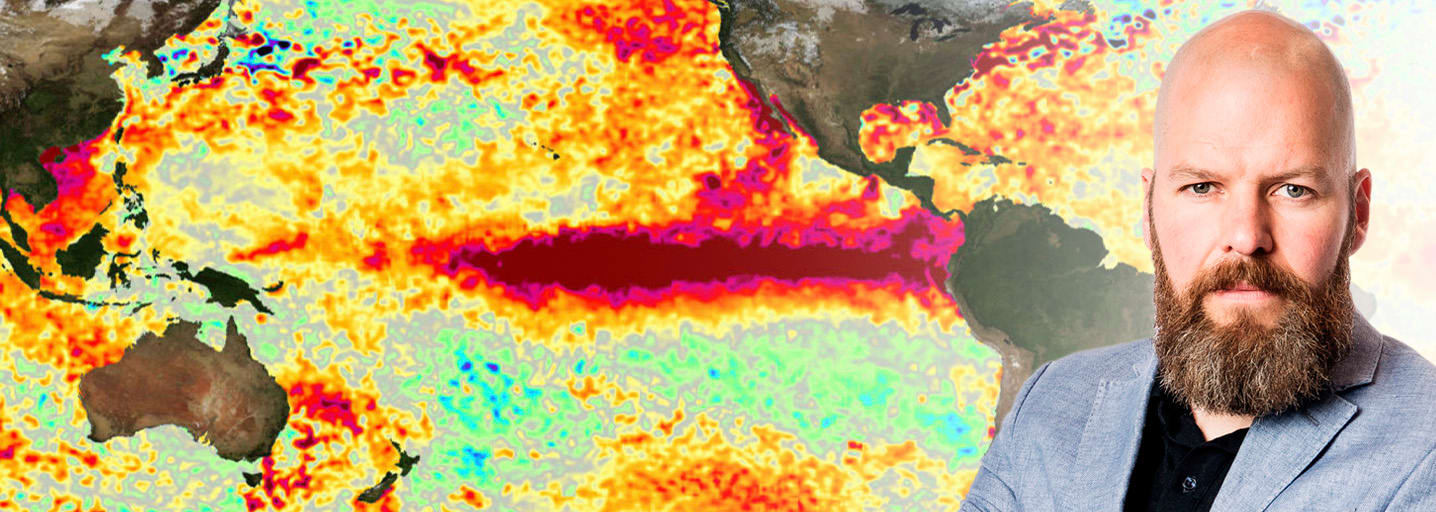
The next El Niño is on its way.
What will be the consequences?
The "climate godfather" has his forecast ready - if he is right, another breathtaking record year awaits.
He is not afraid to stick his chin out, James E Hansen - the adjunct professor who is called the "climate godfather", because he was the first scientist to warn of global warming before the US Congress in 1988.
Several times in recent years he has presented reports that suggest that the effects of the climate threat are more dramatic than we realize - it is happening faster than we thought, the changes are more profound than we may understand.
In the normally reserved and cautious scientific world, he does not shy away from making predictions – speculative ones, according to critics.
But it would have been easier to dismiss him if he had not been proven right earlier:
Two years ago, his team predicted that global warming during the then-ongoing El Niño, although not particularly powerful, would be significantly greater than during previous El Niño events. Which would raise global temperatures to 1.6 degrees.

1.7 degrees in 2027
That's basically how it turned out, and that's why there's reason to listen when he does it again: in a new study, he says that the next time the climate phenomenon El Niño strikes, which usually sends temperatures up to record levels, we could reach 1.7 degrees.
When could this happen? Yes, since a new El Niño is already on the way, James Hansen suggests that it will happen as early as 2027.

It is the aerosols that are the problem, according to Hansen – that the cooling sulfur particles in the atmosphere have decreased so much, partly due to stricter regulations for marine fuel. But there may be other things at work that are more difficult to understand and calculate – is something about to happen to the clouds?
Record low levels
2025 will be the second or third warmest year on record, and everything indicates that 2026 will also break through to the top. Yet all this is just the beginning.
While the extent of ice in both the Arctic and Antarctic is trawling at record low levels, the melting of glaciers will accelerate until mid-century and the oceans will continue to warm for centuries, it can sometimes sound in the debate as if things are under control, yes, as if development is still going in the right direction.

China has reached a peak in its emissions! The forest absorbed more than we thought in Sweden! It will not be 4-5 degrees warmer by the end of the century, but only 2,6!
At the same time, we see all over the world how climate work is being relaxed – the EU's changed rules on fossil cars seem to be the latest example of this.
And 2.6 degrees, even if it can be considered optimistic, does not mean that we will land on solid ground. As Bill Hare, CEO of Climate Analytics, puts it:
"A world with 2.6 degrees means a global catastrophe".

Triggering tipping points
A world this warm will probably trigger "tipping points" that will lead to the collapse of important circulation systems in the Atlantic and the transformation of the Amazon rainforest into savannah.
"All of this means the end of agriculture in Britain and in large parts of Europe, drought and failing monsoons in Asia and Africa, and deadly heat and humidity," Hare tells The Guardian.
All we can do is hope that James Hansen is out cycling.
But even if he is, we cannot ignore the fact that warming is accelerating and appears to continue to do so - and that we do not fully understand why.

Inga kommentarer:
Skicka en kommentar